The rice vs roti debate that plays out in every family WhatsApp group misses the point entirely. What actually drives weight gain in women is hormonal, not regional. Here’s what the science actually shows — and what to do about it.
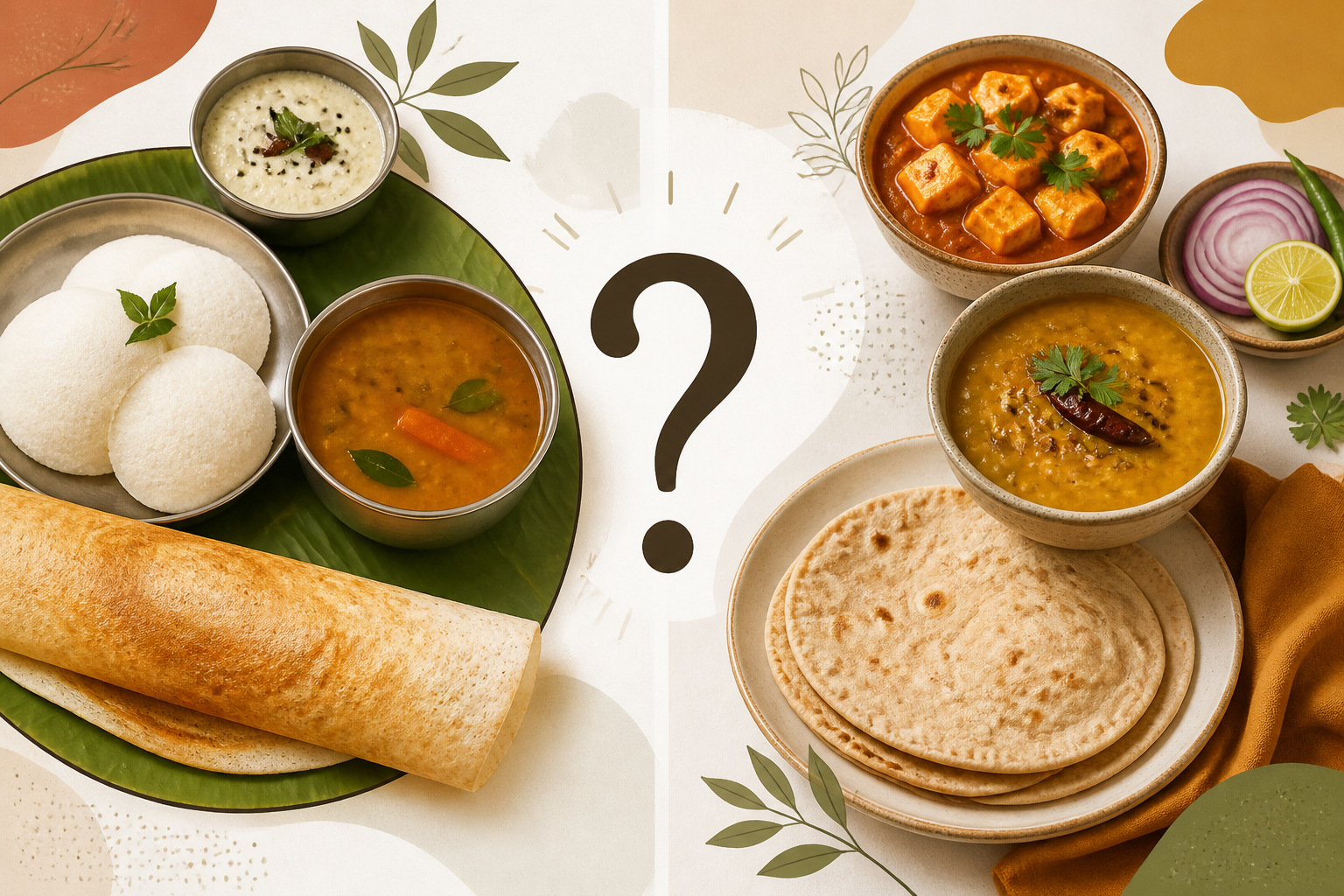
You've probably heard it a thousand times. From your well-meaning aunties in the family WhatsApp group, to the endless debates at office lunch tables, and every online diet forum under the sun: "Rice makes you fat!" "No, it's roti that's the problem!" "South Indian food is healthier!" "But North Indian food has more ghee!"
If you're an Indian woman trying to lose weight in cities like Mumbai, Delhi, Bangalore, Chennai, or Hyderabad, this constant stream of conflicting advice is likely a familiar and frustrating soundtrack to your life. You've probably tried cutting out rice, then switching to brown rice, then trying wheat-free rotis, then going low-carb, then high-protein… and still, the stubborn weight refuses to budge. You feel like you're doing everything "right," yet the scale barely moves, leaving you feeling defeated and confused.
It's exhausting, isn't it? You're an educated, working professional, you understand logic, but somehow, your body just isn't responding to the rules everyone keeps telling you. You're not alone. And here's a secret: this endless rice vs. roti argument? It's a massive distraction. It misses the point entirely.
Let's be direct: whether you primarily eat rice-based dishes like idli, dosa, and curd rice, or you prefer roti, paratha, and dal, the type of grain itself is rarely the primary villain in your weight loss story. Focusing solely on this regional debate is like arguing about the colour of the car when the engine itself is misfiring.
What actually drives weight gain, especially for women, often has far less to do with geography and far more to do with your unique biology and, crucially, your hormones. Your body isn't just a calorie calculator; it's a complex, finely tuned hormonal ecosystem. And when that ecosystem is out of balance, even the "healthiest" regional diet can fail to deliver results.
You see, your body is incredibly intelligent. It's constantly receiving signals from your food, your environment, and your internal state. And these signals, particularly hormonal ones, dictate how your body processes energy, stores fat, and manages hunger. When these signals are misunderstood or disrupted, weight gain becomes an almost inevitable outcome, regardless of whether you're having a plate of steaming idlis or a hearty dal-roti combo.
So, if it's not just rice or roti, what does actually matter? The answer lies in understanding how your body interacts with the food you eat, beyond just its regional origin.
The first thing to understand is the difference between Glycaemic Index (GI) and Glycaemic Load (GL). You might have heard of GI — a measure of how quickly a carbohydrate raises blood sugar. But GI alone tells only half the story. Glycaemic Load is what actually matters, because it accounts for both how quickly sugar enters your bloodstream and how much carbohydrate is in a typical serving.
How common Indian foods compare — GI vs Glycaemic Load:
A plain dosa might have a moderate GI, but eat three large ones and the sheer volume of carbohydrate creates a high glycaemic load — triggering a significant blood sugar spike. The goal isn't to avoid carbs, but to keep the load per meal in check.
Closely tied to this is insulin sensitivity. Insulin is your body's master storage hormone, released every time blood sugar rises. When your cells respond well to insulin, a small amount does the job efficiently. But when they become resistant to it — a condition increasingly common among Indian women — your pancreas overproduces insulin to compensate, and high insulin levels tell your body to store fat rather than burn it. This is one of the most underappreciated drivers of stubborn weight in women, and it has nothing to do with whether you eat idli or paratha.
Equally important is the protein-to-carb ratio at each meal. Protein slows digestion, blunts blood sugar spikes, and keeps you full for longer. The same plate of rice eaten alongside a generous bowl of dal and a sabzi will behave very differently in your body than plain rice with just a pickle. Fibre works similarly — it buffers the absorption of sugar, adds bulk so you feel satisfied, and feeds the gut bacteria that support metabolic health. Whether it's sambar, thoran, or a rajma-based gravy, the fibre and protein you build around your carbs is where the real metabolic action happens.
Meal timing matters too. Eating at consistent times, avoiding heavy meals late at night, and giving your digestive system adequate rest between meals can meaningfully improve how your body manages blood sugar over the course of a day. None of this requires a dramatic overhaul of what you eat — just a more thoughtful relationship with when and how.
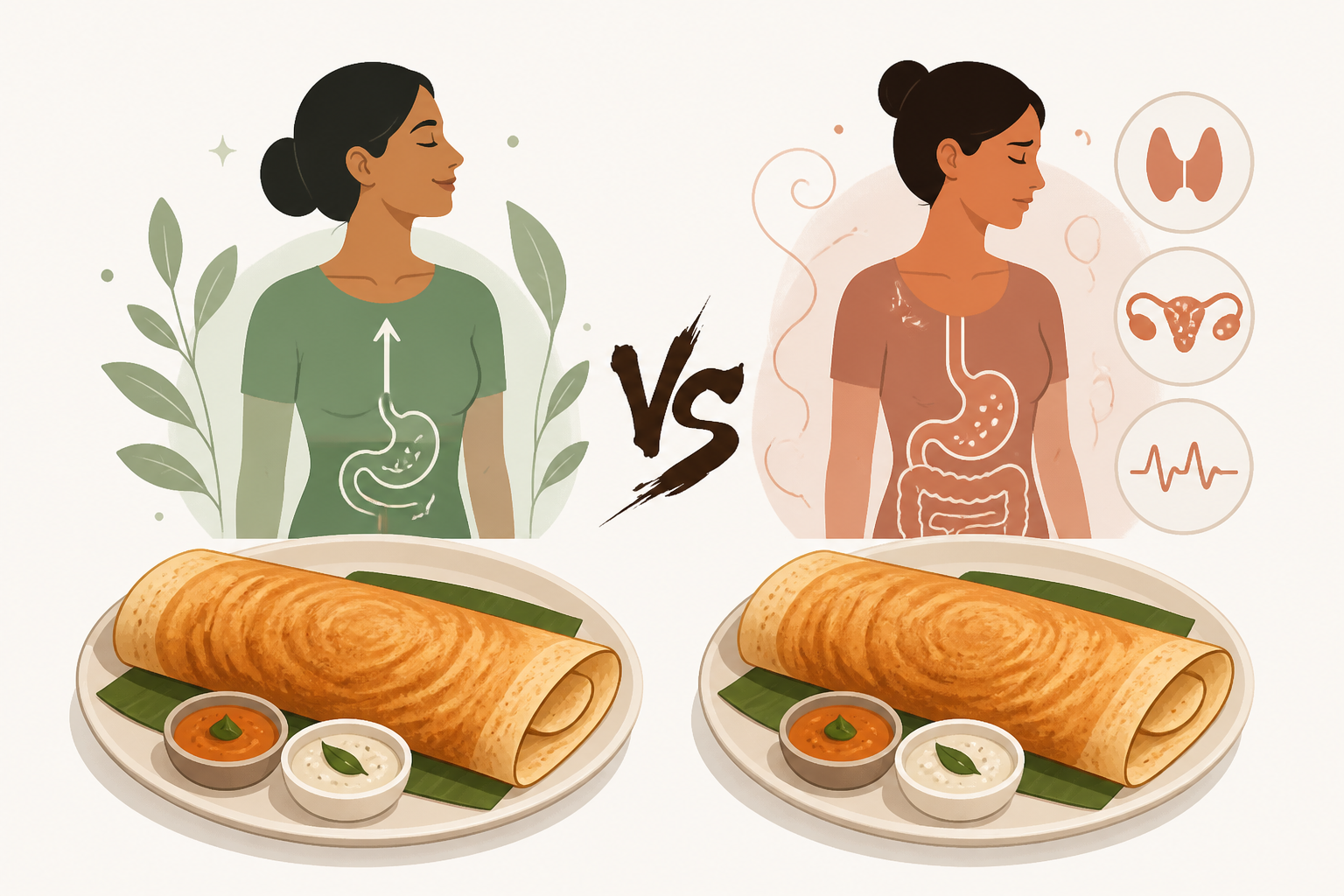
This is the part no WhatsApp diet group ever talks about. You might have a friend who eats dosa every morning and stays effortlessly slim, while you've switched to oats and still can't shift the weight. That's not willpower. That's biology.
Underlying hormonal conditions fundamentally change how your body processes food, creating a unique metabolic landscape for each woman. Polycystic Ovary Syndrome (PCOS) is remarkably common among Indian women, and insulin resistance is one of its defining features. This means your body is already struggling to manage blood sugar efficiently, making you far more prone to fat storage even on a "normal" diet. Similarly, an underactive thyroid can significantly slow your metabolism in ways that a calorie-restricted diet alone simply cannot fix. These are not minor issues; they are powerful biological forces shaping your weight journey.
Even without a formal diagnosis, many women develop insulin resistance due to chronic stress, disrupted sleep, and the particular pace of urban Indian life. All these factors elevate cortisol, your body's stress hormone, which in turn raises blood sugar and promotes stubborn belly fat storage. So, while you might be diligently tracking your food, your body could be responding to a symphony of internal signals that are completely overlooked by generic diet advice.
Your gut microbiome plays a quiet but powerful role in this intricate dance too. The health of your gut bacteria influences how you absorb nutrients, produce certain hormones, and respond to the foods you eat. Two women eating identical meals can have genuinely different metabolic responses based on the state of their gut health. This is precisely why there is no single "right" regional diet that works for every Indian woman. Your body has a unique context — hormonal, metabolic, genetic — and that context shapes how every mouthful of food behaves inside you.
The shift in thinking that makes the biggest difference isn't subtraction — it's addition. Rather than asking what to cut out, start asking what to build your meals around.
The order in which you eat matters more than you think:
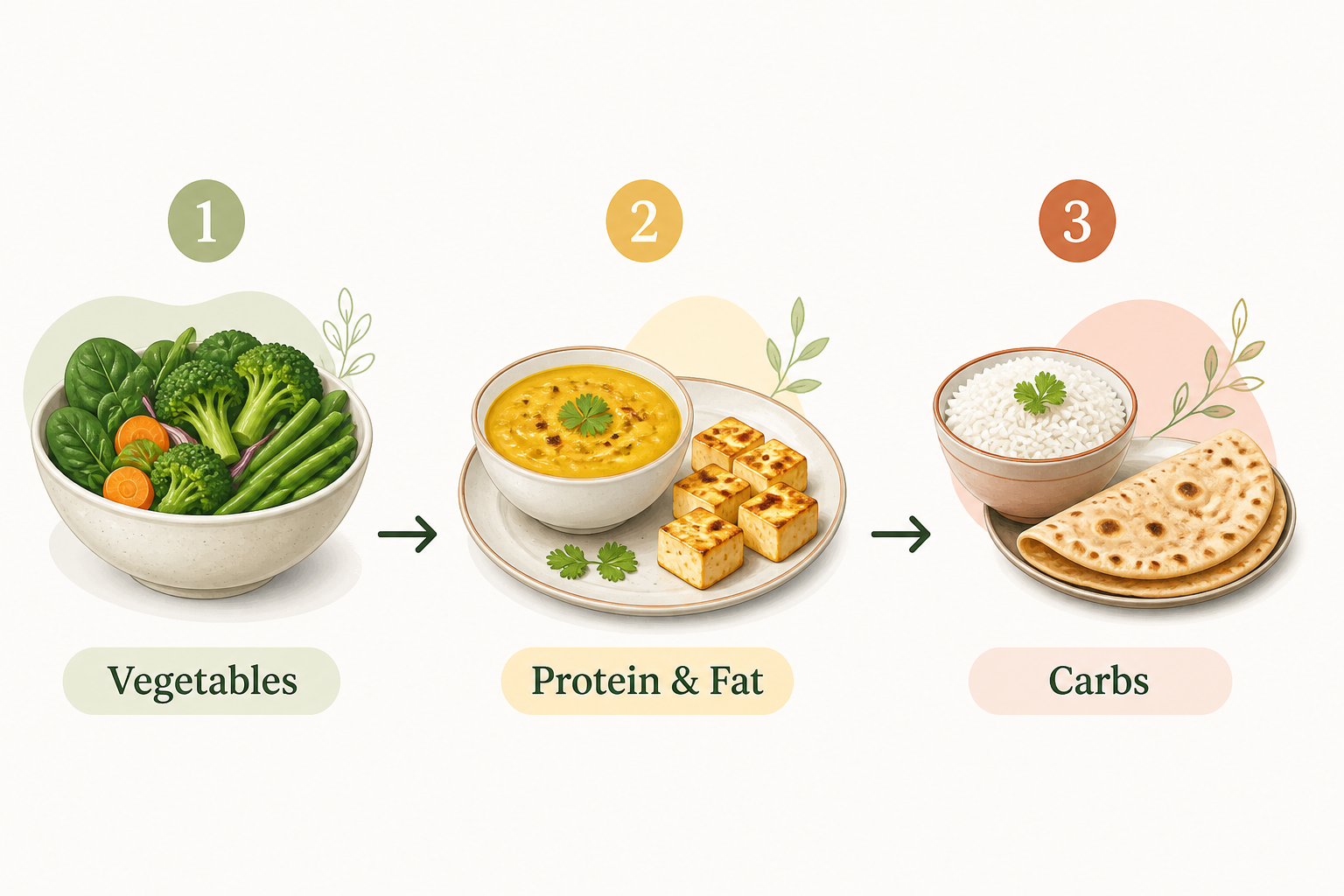
Starting with vegetables, then protein and healthy fats, and eating your rice or roti last results in measurably lower blood sugar spikes than eating carbohydrates first. It sounds almost too simple, but this strategic sequencing can make a significant difference in how your body processes your meal.
Better-composed meals — whether you eat South Indian or North Indian:
Always prioritise protein — whether it's a generous serving of dal, paneer, eggs, chicken, fish, or a handful of mixed nuts, leading every meal with protein will naturally moderate the blood sugar impact of whatever carbohydrate follows. And don't shy away from healthy fats like ghee or coconut oil. These fats are essential for supporting hormone production, improving satiety, and helping your body absorb fat-soluble nutrients. The pervasive fear of fat that dominated diet culture for decades has, quite frankly, not served Indian women well.
Finally, be mindful of portion sizes on the carbohydrate side, because glycaemic load is ultimately a volume game. A smaller, well-portioned serving of rice or roti eaten alongside generous amounts of dal, curd, and two vegetable dishes will serve your metabolism far better than a large plate of plain curd rice, however comforting that might be after a hard day. This is about balance and strategic combination, not outright elimination.
If you've been doing everything "right" — eating cleaner, exercising, cutting portions — and the weight still won't move, please hear this: it is not a failure of discipline. It is a signal. Your body is telling you that something hormonal might be at play, and that changing what's on your plate alone won't fix what's happening underneath it.
Losing weight for the last time truly starts with understanding your body — not just following someone else's regional diet template. If you've tried the diets and hit a wall, the next step isn't another elimination phase. It's finding out what your hormones are actually doing.
At Shakti, we're gynaecologists who specialise in exactly this. We see women who've "tried everything" — and we help them understand the real reason the weight isn't moving. Because when you address the root cause, everything else finally starts to make sense.
→ Take our Free Weight Assessment — speak to a gynaecologist at Shakti
You've read the article. Your body already knows something is off. The next step is finding out what - with a doctor who actually specialises in this."
★★★★★ 4.8/5 rated | 100% Private |Trusted by Women at All Stages
.png)

.webp)