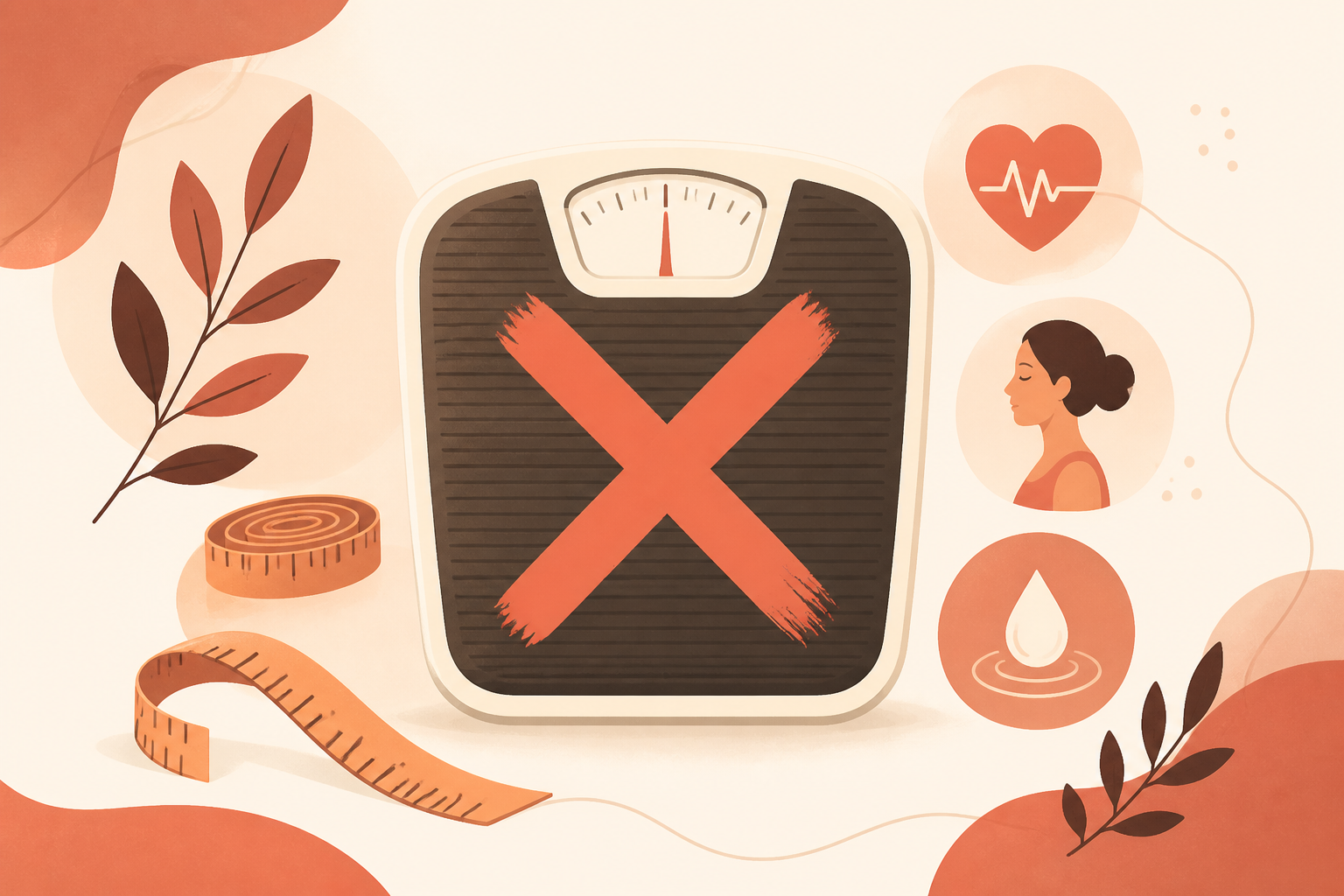
Women with PCOS don't struggle to lose weight because they lack willpower. They struggle because their hormonal and metabolic environment is working against every standard piece of advice they've been given. Here's what's actually happening — and what actually helps.
She had tried everything.
Low carb. Intermittent fasting. Daily walks. Calorie counting. Cutting sugar. Cutting dairy. Cutting everything, eventually, and surviving on salads and guilt while the scale refused to move.
"You just need to be more consistent," her doctor said.
She had been the most consistent person in every room for two years. The weight didn't care.
What nobody had explained to her — what nobody explains to most women with PCOS — is that her body was not behaving like a normal metabolic system. The standard equation of calories in, calories out had stopped applying to her physiology years ago. She wasn't losing because she couldn't out-discipline a hormonal environment designed to resist her.
This is the reality for a significant proportion of the estimated 1 in 5 Indian women with PCOS. And it is a reality that most advice — medical, social, and otherwise — is completely unprepared for.
PCOS weight gain is not ordinary weight gain. It is hormonal fat — driven by a specific combination of insulin resistance, elevated androgens, cortisol dysregulation, and disrupted hunger signalling — that behaves completely differently to the weight gained from simply eating more than you need.
Here is what is happening inside.
Insulin resistance is present in a significant majority of women with PCOS. When cells resist insulin's signal, the pancreas compensates by producing more. Chronically high insulin instructs the body to store fat — particularly visceral fat, concentrated in the abdomen — and actively resists its release. High insulin levels trigger fat storage and lead to more cravings, irregular periods, PMS, bloating, and fatigue. It also directly stimulates the ovaries to produce more androgens, which deepens the PCOS cycle.
Elevated androgens — testosterone and its relatives — promote fat storage specifically in the abdominal area. This is why PCOS weight tends to sit differently to the fat women gain elsewhere: it is denser, more stubborn, and more metabolically active in ways that further disrupt hormones.
Cortisol adds a third layer. Chronic stress, which is endemic in the lives of urban Indian women, elevates cortisol — which both promotes abdominal fat storage independently and worsens insulin resistance. This is why periods of high work pressure reliably cause PCOS symptoms to flare: the stress-hormone-fat triangle is self-reinforcing.
Leptin resistance — less discussed but increasingly understood — means that the hunger and satiety signals many women rely on to guide their eating are themselves distorted in PCOS. You can feel genuinely hungry shortly after eating a full meal. You can feel no satisfaction despite adequate food intake. This is not weakness. It is a hormonal communication failure.
"Eat less and move more" is the advice given to most women with PCOS who present with weight concerns. It is the worst possible framing for a condition driven by insulin resistance and cortisol dysregulation.
Eating less — particularly skipping meals or severe caloric restriction — spikes cortisol, which worsens insulin resistance and instructs the body to protect fat stores more aggressively. Many women with PCOS who eat very little are metabolically in a worse state than those eating regular, balanced meals — because the starvation signal accelerates the hormonal cascade driving the weight.
Even a 5% reduction in weight in women with PCOS can meaningfully improve insulin resistance, hormone levels, menstrual cycles, fertility, and quality of life — but reaching that 5% requires an approach that works with the hormonal environment, not against it. That means prioritising blood sugar stability, not just calorie reduction. It means managing cortisol through sleep, stress, and meal timing as much as through food choices. It means understanding that the same meal eaten at different times of day, or under different stress conditions, has different metabolic outcomes in a PCOS body.
The most important shift in thinking about PCOS and weight is this: the weight is not the cause of the problem. It is a symptom of the problem.
When doctors advise women with PCOS to lose weight in order to improve their PCOS — without addressing the insulin resistance, androgen excess, and cortisol dysregulation driving the weight — they are asking the symptom to solve the cause. It does not work that way.
The women who make real, lasting progress with PCOS weight are almost never the ones who simply tried harder. They are the ones who finally had a conversation that addressed the hormonal environment — the specific pattern of their insulin resistance, the specific role of androgens in their case, the specific lifestyle and stress context that was sustaining the cycle. And they are the ones who were met with facts rather than judgment.
That conversation is not complicated. But it requires a doctor who is actually willing to have it.
At Shakti, our gynaecologists don't just look at your reports. They look at you — your lifestyle, your stress, your patterns, your history. Because most unexplained symptoms have a root cause. It just takes someone willing to find it.
If something in this resonated, you don't have to keep guessing.
Follow @heyshaktii for more honest insights into women's health. Or speak to one of our specialists — we will take the time to understand what's really going on in your body.
Book at heyshakti.com
You've read the article. Your body already knows something is off. The next step is finding out what - with a doctor who actually specialises in this."
★★★★★ 4.8/5 rated | 100% Private |Trusted by Women at All Stages
.png)

.webp)